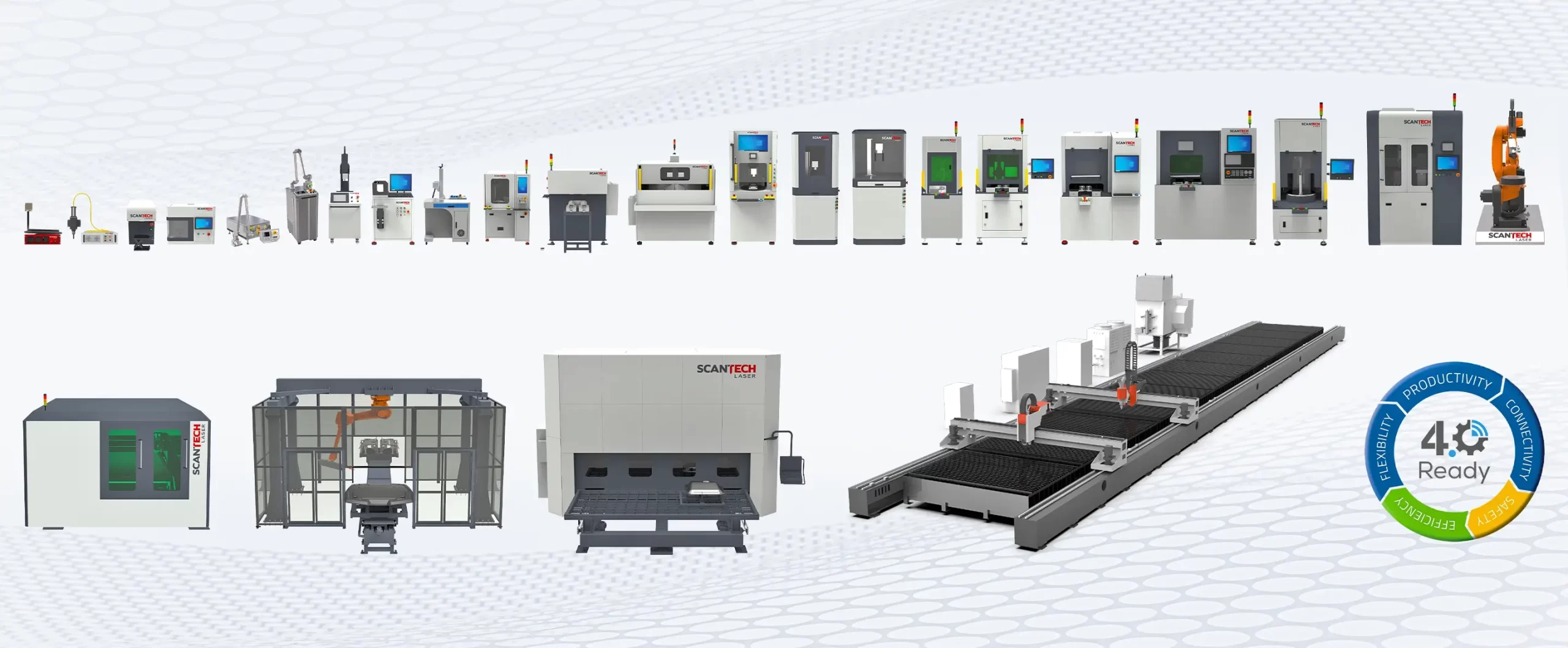
Industrial Laser Machines
Built For Production
Marking, cutting, welding, cleaning, cladding, hardening, scribing and drilling — designed, manufactured and serviced under one roof in Navi Mumbai, India.
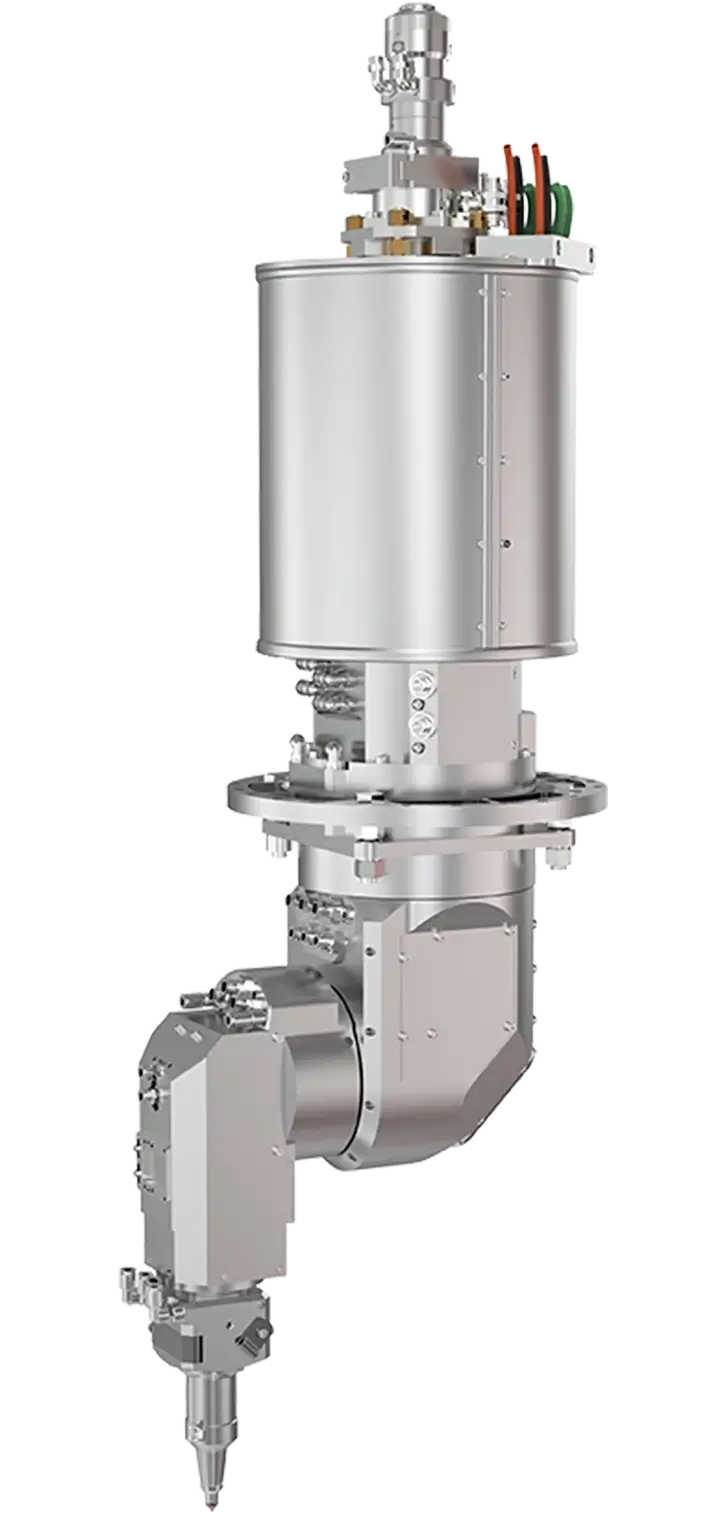
Dynamic 5-axis heads, capacitive height tracking and closed-loop gas control for tube, profile and formed sheet metal components.
GMP-friendly tablet, capsule and blister laser systems with vision verification and 21 CFR Part 11 ready data handling.
Every Scantech platform shares the same core: a rigid granite or welded-steel base, industrial fiber or ultrafast source, in-house motion control and a process recipe validated on your own sample parts before shipment.
Fiber, UV and green marking for permanent 2D codes, VIN plates, medical device UDI and annealed stainless steel identification.
Explore 02
Flat sheet, tube and 5-axis 3D cutting cells with automatic nozzle changing, nesting software and load/unload automation.
Explore 03Wobble, scanner and robotic welding for EV busbars, hairpin stators, battery housings and hermetic medical assemblies.
Explore 04
Dry, media-free removal of rust, oxide, paint, enamel and mould release — handheld or fully automated with fume extraction.
Explore 05Picosecond and femtosecond scribing for silicon wafers, thin-film PV, ceramics and brittle substrates with negligible HAZ.
Explore 06High-speed cladding of brake discs, hydraulic rods and mill rolls with under 5% dilution and metallurgical bonding.
Explore 07Selective case hardening with pyrometer closed-loop control — no quench media, minimal distortion, repeatable depth.
Explore 08Micro-hole drilling for filters, fuel injectors, turbine cooling holes and transdermal medical components down to microns.
Explore 09
Tablet and capsule laser printing, blister coding and pack serialisation with inline vision inspection and audit trails.
ExploreBuying a laser is a process decision, not a catalogue decision. Our engineers run your part in the R&D lab, record parameters, measure metallurgy and only then define the machine configuration you actually need.
From e-mobility battery lines to diamond cutting rooms, each industry brings its own tolerance stack, traceability rules and uptime targets. We engineer to those constraints.
Busbar and hairpin welding, battery-tray cleaning, VIN marking, brake-disc cladding.
Tablet printing, blister coding, serialisation and ink-free GMP identification.
Flat, tube and 3D cutting with nesting, automation and burr-free edge quality.
Hardening of guideways, cladding of rods and traceable component marking.
Ultrafast wafer scribing, PCB depaneling, connector and sensor micro-welding.
UDI marking, hermetic welds, cannula cutting and micro-drilling on implant alloys.
Turbine cooling holes, titanium welding and repair cladding of high-value parts.
Green and femtosecond cutting, coring, bruting and inscription of natural stones.
Four variables explain most of the quality difference between a good laser process and a failed one. Here is how we control them.
Millisecond pulses melt, nanosecond pulses vaporise, picosecond and femtosecond pulses ablate almost athermally. Choosing the wrong regime shows up as recast layer, micro-cracking or discoloration. We select the regime from material conductivity, thickness and the acceptable heat-affected zone, then verify with cross-section metallography.
Spot size, focal position stability and beam quality (M²) govern energy density at the workpiece. Our systems use collimated fiber delivery, thermally stable optics and, where required, capacitive or vision-based height tracking so that spot conditions stay constant across large or deformed parts.
Marking and welding quality depend on how precisely galvo scanning is synchronised with axis motion and part handling. We tune acceleration profiles, skywriting delays and on-the-fly tracking so that first and last part in a shift look identical.
Every enclosure is designed towards Class 1 operation with interlocks, viewing windows of the correct optical density, and fume or particulate extraction sized to the process. Documentation, CE-oriented risk assessment and operator training are part of delivery, not an afterthought.
Tell us the part, the volume and the tolerance. You get an application review, a sample trial report and a straight technical recommendation — including when a laser is not the right answer.
Laser processing removes consumables, chemicals and abrasive media from the shop floor. See how our machines are built and validated before they reach yours.
Practical, test-based articles written by the team that runs the trials — not marketing summaries.

Comparative trials showing how pulse duration changes recast layer, edge taper and heat-affected zone on the same alloy.

Deposition rates, dilution control and wear data behind coated cast-iron discs that cut non-exhaust particulate emissions.

Forty-plus verified applications from electrode foil cutting and hairpin welding to enamel removal and tyre marking.
Still comparing options? Our engineers answer the same questions every week — here are the short versions.
Ask Our EngineersA 1064 nm fiber laser is the standard choice for permanent, corrosion-resistant annealing and engraving on stainless steel and most metals. For light-coloured polymers, PET and PP, a UV (355 nm) or green (532 nm) source produces high-contrast cold marks without melting or charring the substrate. Our applications lab runs sample trials on your own parts before machine selection.
High-speed laser cladding deposits a metallurgically bonded, wear-resistant layer on grey cast-iron brake discs at deposition rates far above conventional laser metal deposition, with dilution typically under 5% and minimal heat input. The coated disc dramatically reduces non-exhaust particulate emissions and extends service life, supporting Euro 7 and Bharat Stage 7 compliance.
Standard machines ship from our Navi Mumbai plant after factory acceptance testing; special purpose machines follow a defined design-review, FAT and SAT sequence. Every delivery includes installation supervision, operator and maintenance training, spare-part kits and remote diagnostic support through our global service network.
Yes. We build special purpose machines and robotic laser cells with part handling, vision alignment, fume extraction, Class 1 enclosures and PLC or MES connectivity, so a laser process can be retrofitted into an existing conveyor, indexing or robot-fed line.
Machines are delivered with operation and maintenance manuals, electrical and pneumatic schematics, laser safety documentation, calibration records and — for regulated industries — IQ/OQ support documents and data-integrity features suitable for pharmaceutical and medical device audits.
Founded in 1991, Scantech Laser designs, manufactures, installs and services its own machines — the same team answers the phone three years after commissioning.
Manufacturing footprint, capability matrix and installed-base overview. Available on request from our sales engineering desk.
Application articles on automation, connected laser cells and process monitoring for smart factories.
Market and technology outlook for industrial laser processing across automotive, pharma and electronics.
Share your drawing, material and cycle-time target. Our application engineers respond with a technical assessment — not a generic brochure.